

URL: /tyre-puncture-repair-methods
Target Keywords: mobile puncture repair, mobile flat tyre repair, on-site tyre replacement
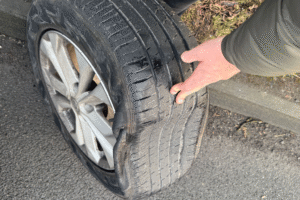
Two Different Things Called a “Repair”
There’s a permanent fix and there’s a temporary plug. They’re not the same. Here’s the difference.
The confusion is understandable. Both are sold as “puncture repairs.” Both cost money. Both get you back on the road. But one is designed to last the life of the tyre. The other is designed to get you to a garage that can do the job properly.
The problem is, not everyone knows which one they’re getting.
The External Plug (String Plug)
What it is: This is what you buy in a kit at petrol stations. A sticky string pushed into the hole from outside using a special tool. The string expands to fill the gap and the excess is trimmed flush with the tread.
How it works: It fills the hole by compression. The tar-like coating helps it seal against the rubber. But it only fills the channel—it doesn’t address what’s happening inside the tyre.
What it doesn’t do: It doesn’t seal the inner liner. The inner liner is the layer of the tyre that actually holds air. It’s like the inner tube in an old-style tyre, but it’s bonded to the inside of the casing. When a puncture happens, that liner is damaged. A string plug leaves it damaged.
What happens over time: Air under pressure will find the path of least resistance. Over weeks or months, it starts tracking around the outside of the plug. Moisture follows. The steel belts in the tyre structure can corrode. The plug itself hardens with heat and weather, losing its seal. In some cases, the plug can work loose or even eject at speed.
The time factor: It’s quick. Five minutes and you’re done. That’s part of the appeal. But speed isn’t the same as effectiveness.
The cost factor: It’s cheap. Kits are a tenner. Some places will fit one for £15-20. But cheap now can mean expensive later.
The Internal Patch-Plug
What it is: This is a combined unit—a patch that bonds to the inner liner and a stem that fills the puncture channel. It looks like a mushroom: wide base (the patch) with a stem sticking up.
How it works: The tyre comes off the wheel completely. The inside is inspected. The area around the puncture is cleaned and buffed to remove contaminants and create a surface that will bond. A chemical vulcanising fluid is applied. The patch-plug is inserted from inside, the stem pulled through the hole, and the patch rolled firmly onto the inner liner. The chemical bond forms over several minutes, making the patch part of the tyre structure.
What it does: It restores the inner liner. It seals the puncture channel without putting stress on the surrounding rubber. It prevents air and moisture from tracking into the tyre structure. The tyre goes back on the wheel and gets balanced.
The time factor: 25-35 minutes. Longer because more is being done. The tyre has to come off, get inspected, get prepped, get repaired, and go back on balanced.
The cost factor: More than a string plug. Usually £25-35. But you’re paying for a proper repair rather than a temporary block.
What You Can’t See Matters
When a tyre is still on the wheel, you can’t see what’s happening inside. You can’t see if the inner liner is damaged beyond the puncture site. You can’t see if moisture has already got in. You can’t see if the structure is compromised. You can’t see if the tyre has been run flat—which often causes internal damage invisible from outside.
A proper repair involves looking at all of that before deciding whether the tyre can be saved. That’s why the tyre has to come off the wheel. Anyone who offers to repair a puncture without demounting the tyre is working blind.
When a Puncture Can’t Be Repaired
Some punctures aren’t repairable no matter what method is used:
- Too close to the sidewall.The shoulder and sidewall flex too much. Any repair there will fail from repeated bending. Industry guidelines specify the central ¾ of the tread as the repairable area.
- Too large.Generally, punctures over 6mm (about the width of a small screwdriver) are beyond repair. The hole is simply too big for the structure to hold.
- The tyre was driven on while flat.This damages the sidewall internally. You can’t see it, but the tyre’s structure is compromised. Repairing the puncture doesn’t fix the hidden damage.
- Multiple punctures close together.Too many holes in one area weakens the structure. Even if each could be repaired individually, together they create a weak spot.
- Tyre is already worn low.If there’s not much tread left, repairing a puncture is false economy. The tyre will need replacing soon anyway.
- Previous repairs exist.A tyre can only be repaired so many times. There are limits on how close repairs can be to each other.
A proper repair starts with checking these things. If it’s not repairable, you should be told why—and ideally shown why if the tyre is off the wheel.
What You Should Know If You Need a Puncture Fixed
If someone offers a quick cheap repair: Ask if they’re taking the tyre off the wheel. If the answer is no, you’re getting a string plug. That’s fine if you know that’s what you’re getting and you’re using it as a temporary measure. It’s not fine if you think you’re getting a permanent repair.
If you’ve had a string plug fitted before: Mention it when you book a proper repair. The fitter needs to know because the old plug may have caused internal damage. The tyre might not be repairable now even if the new puncture is in a good spot.
If the tyre was run flat: Even if you only drove a short distance, tell the fitter. The sidewall may be damaged internally. A repair might not be possible even if the puncture itself looks fine.
If the puncture is in the sidewall: It’s not repairable. Full stop. Don’t let anyone tell you otherwise. Sidewall damage means a new tyre.
What We Charge and Why
A proper patch-plug repair costs more than a string plug because it’s more work and more equipment. The tyre has to come off, get inspected, repaired properly, and go back on balanced. That’s 30 minutes of work plus materials.
If we take the tyre off and find it can’t be repaired, you’ve still paid for the time to check. That’s fair—you now know the tyre needs replacing rather than finding out later the hard way. You’re not paying for a repair that wasn’t done; you’re paying for the diagnosis that saved you from a dangerous assumption.
Some places waive the inspection fee if you buy a new tyre from them. That’s common practice. We do the same. But if you take the car elsewhere for the new tyre, the inspection time still has to be covered.
Why This Matters
A tyre is the only thing connecting your car to the road. It holds air at pressure, carries the vehicle’s weight, transmits braking and steering forces, and does it all while flexing constantly.
A proper repair respects that. A temporary plug just hopes for the best.
Most drivers never see inside their tyres. They don’t know what a proper repair looks like versus a bodge. That’s understandable—it’s not something you deal with every day. But knowing the difference helps you make an informed choice when you do need a fix.
The goal isn’t to scare anyone. It’s to explain why proper repairs take longer and cost more—and why that time and cost are worth it.
